
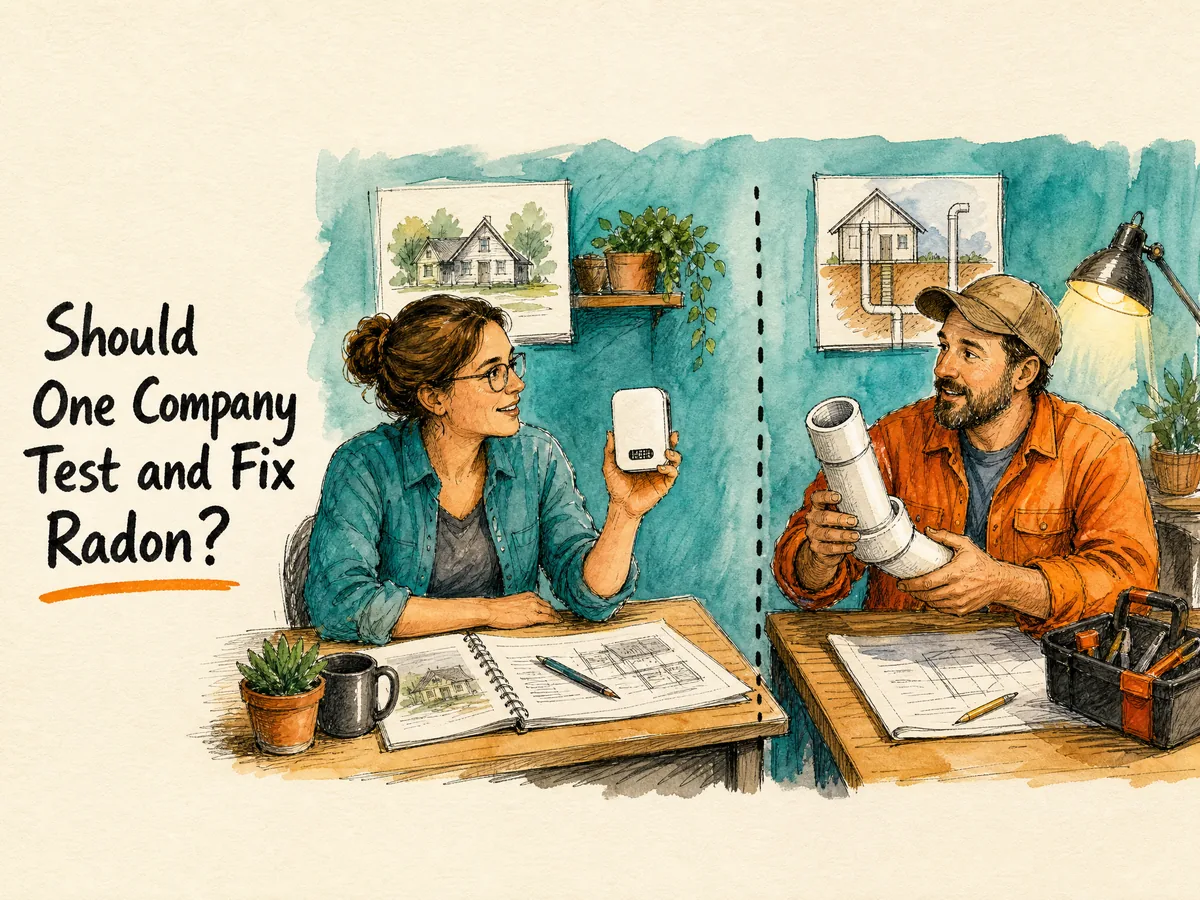
Should the Same Company Test Your Home for Radon and Fix It?
Quick Answer: EPA says that when the same firm tests a home and also installs the radon system, there may be a conflict of interest. It is not automatic, and many companies do both fairly. The cleanest approach is to have the first test done by someone who will not bid on the fix, then get more than one estimate.
Every few months I hear some version of the same story. A homeowner calls a radon company to test. The company comes out, sets a device, reads the result and, a few days later, delivers two pieces of news: the number is high, and they can fix it. It is a neat package, and a lot of people take it. Some of those people are happy with it. Some of them wonder, a year later, whether the number was as high as it sounded.
I am not here to tell you that companies who do both are crooked. Most are not. I am here to explain what EPA and Pennsylvania DEP say, so you can decide how much separation you want. The decision is mostly about the first test, which is the one that sets the price of everything after it.
What EPA says
EPA’s guide for real estate transactions, Radon Testing in Real Estate Transactions, notes that when the same firm tests a home and also mitigates it, there may be a conflict of interest. It says that in plain language and does not say the arrangement is wrong. The point is that the person reading the test has a stake in what the test says.
Think about it the way you would think about a mechanic who tells you your car needs work and also does the work. Most of them are honest. You still get a second opinion on the big jobs.
What Pennsylvania DEP’s structure says
DEP certifies testing and mitigation as separate activities. A company can hold both certifications, and the regulations treat them as different jobs with different rules. Under 25 Pa. Code § 240.303, each building has to be tested after mitigation, and under § 240.310 the certified individual is responsible for making sure the test follows DEP’s protocols. A mitigator is expected to deal with testing, since the post-installation test is part of the job. So in Pennsylvania, “does the same company do both” has two different answers, depending on which test you mean.
I explain the three DEP certification types in PA DEP radon certification: tester vs. mitigator vs. laboratory.
Two tests, two answers
| Test | Why separating helps | How I would handle it |
|---|---|---|
| The first test, the one that decides whether you need a system | The person reading it may be pricing the repair. The number sets everything after it. | Use a certified tester who will not bid on the fix, or get a second test from someone else before you sign |
| The post-installation test, the one that decides whether the fix worked | The company has a stake in a passing number, and DEP says the mitigator reports the result to the state. | Ask for the tester’s certification number on the report. EPA recommends an independent tester or a self-test |
The second row is the one people overlook. After the system goes in, the company that installed it often runs the test, and that is allowed. EPA recommends an independent tester or a self-test, and DEP’s rules say the results must be reported unless someone other than the mitigator performs the test and the client does not share the results with the mitigator. If you do the test yourself or hire someone independent, you control the number.
When doing both is fine
It can be fine, and sometimes better. A company that tests and mitigates sees the whole picture, and a long chain of handoffs creates its own problems. The situations where I would not worry:
- You already have a high result from a test you ran or hired out, and you are shopping for the fix.
- You are getting more than one estimate, as EPA recommends, and the company that tested is one of several.
- The test report lists a certified tester, the dates, the device and the conditions, so you can see it was done properly.
When I would separate them
- A home sale, where the result moves money. EPA says the buyer or the seller can hire a qualified tester and that it is very often a home inspector. Having someone other than the mitigation bidder run the test keeps the result clean for both sides.
- Any time the test result seems out of line with what you expected, such as a very high number after an earlier low one. Repeat it with a different party.
- A “free test” that arrives with a sales call. PA DEP puts a home kit at about $20 to $30, so a screening test is not a big expense. If a test is free, the cost may be in the next step.
For the sale scenario, the 48-hour radon test in a home sale explains how EPA says the test should be run and documented, and does a home inspection include radon testing covers the inspector question.
How to protect yourself either way
- Get the test report in writing, with the tester’s DEP certification number, dates, device type and location.
- If the result is high and the company that tested wants the job, get at least two more estimates. EPA says to get more than one.
- Follow EPA’s follow-up rule on your own. A first result of 4 pCi/L or higher needs a follow-up test, and if it is above 8, take a second short-term test right away. How to read your radon test results has the full table.
- After the system is installed, ask for the post-installation report with certification numbers, and consider an independent test.
- Look every company up in DEP’s Radon Services Directory.
A word on being fair
I would not tell anyone to avoid a company because it does both. Plenty of good mitigators test, because the post-installation test requires it. The point is to know where the incentives sit and to build in one check that does not depend on the person who profits. A second opinion on a first test costs little. A system you did not need, or a result nobody questioned, costs more.
If you are ready to compare companies, start with radon mitigation near you in York County, and use 10 questions to ask a radon mitigation company before you sign when you talk to them. Our YouTube channel has short videos, and the York PA Radon Pros homepage has the full list.
Frequently asked questions
Is it a conflict of interest if the same company tests and fixes radon?
EPA says there may be a conflict of interest when the same firm tests and mitigates. It is not automatic, and many companies do both fairly, but a second opinion on the first test is a reasonable step.
Can a radon mitigator do the post-installation test in Pennsylvania?
DEP’s rules require each building to be tested after mitigation, and the mitigator reports the result to the state. EPA recommends an independent tester or a self-test.
Should I get a second radon test before hiring someone to fix it?
EPA says a first result of 4 pCi/L or higher needs a follow-up test, and a result above 8 calls for a second short-term test right away. Doing that with a different party also helps with the conflict question.
Are free radon tests a red flag?
Not always, but a free test usually comes with a sales call. PA DEP says home kits cost about $20 to $30, so you can run a screening test yourself and shop for estimates with the result in hand.
Who should test a home during a sale?
EPA says the buyer or the seller can hire a qualified tester, very often a home inspector. In Pennsylvania, DEP certifies radon testing, so ask for the certification number.
How many estimates should I get for a radon system?
EPA says to get more than one, along with references.
Sources and further reading
- EPA: Radon Testing in Real Estate Transactions (EPA 402/K-24/001, March 2024)
- EPA: Consumer’s Guide to Radon Reduction
- 25 Pa. Code § 240.303, Reporting and post-mitigation testing
- 25 Pa. Code § 240.310, Testing protocols
- PA DEP: Radon Certification
- PA DEP: Radon Services Directory
- PA DEP: Radon in the Home